common q’s answered
New to body or energy work? Here are frequently asked questions as they relate to my approach:
What if I need to cancel an appointment?
Cancellation of a session must be made through call, text, or email 24 hours before the start time of the session. If a cancellation occurs in less than this window, payment in full will be due to body drift healing arts practice within one week of the scheduled appointment. Under unforeseen circumstances (sickness, emergency, etc), leeway is offered.
What if I need to reschedule an appointment?
If you must reschedule, please do so right away. Within reason, I ask that clients reach out 24 hours before an appointment should they need to reschedule. Again, under unforeseen circumstances, I am flexible. Should you show signs of illness, please contact me immediately. For clients who reschedule within a day’s notice more than 2x’s, I ask that you pay the charge for holding the space as other clients are unable to book in, and this results in a loss on my end.
What is bodywork & manual therapy?
Bodywork refers to various therapeutic practices that involve physical manipulation and touch to enhance the well-being of an individual. It encompasses a wide range of techniques and modalities aimed at improving physical, mental, and emotional health. In simpler terms, bodywork is a hands-on approach to promoting overall wellness by addressing tension, stress, and discomfort in the body through skilled touch and manipulation. It can include massage, acupressure, cupping, and other practices that focus on the body’s structure and movement. The goal of bodywork is to support relaxation, reduce pain, and enhance the body’s natural ability to heal itself.
Manual therapy is the application of hands-on techniques to body tissues with intent to therapeutically asses and treat. Through proper assessment of the involved body structures, a physical therapist can utilize manual therapy techniques to enhance the healing process and correct positional faults of the irritated tissues. Some manual therapy techniques utilized by include soft tissue mobilization, myofascial release, strain-counter strain, muscle energy techniques, joint mobilizations and manipulations, and mobilization with movement. Manual therapy can be utilized to assess dysfunction, increase joint range of motion, decrease pain, and improve healing. Both bodywork and manual therapy can be utilized as part of a plan to promote an individual’s overall health and wellness. However, the education and skill level needed to practice manual therapy is much more comprehensive than Spa style / Swedish massage.
Who is bodywork ‘good’ for?
Anyone, everywhere, all around the world – the only time to *not* get a massage would be immediately following a major accident. There are contraindications depending on particular health conditions utilizing different modalities. In addition, local injury sites / acute pain may be avoided depending on the severity of pain / time of injury. These scenarios will be addressed on a case-by-case basis and is the main reason for conducting an intake / assessment.
Why get a massage?
One of the immediate benefits of bodywork is that it is calming and deeply relaxing. This occurs due to the release of endorphins – the brain chemicals (neurotransmitters) that produce feelings of well-being. In addition, stress hormones, such as adrenalin, cortisol, and norepinephrine, are reduced. Keeping stress levels down is, as many studies have indicated, beneficial for the immune system. A few additional physical benefits of bodywork include:
- reduced muscle tension
- improved circulation
- stimulation of the lymphatic system
- increased joint mobility and flexibility
- improved recovery of soft tissue injuries
- heightened mental alertness
- reduced anxiety and depression
- pain reduction
- touch is one of our basic needs for survival as humans & it feels nice 🙂
Do I need to be fully undressed to enjoy a massage? No! For Thai massage, you will be fully clothed on a mat. I encourage comfy clothing that you would wear to the gym. For table massage, I will always leave the room for you to undress in privacy to your comfort level. When I return and you are on the table, you will be professionally draped at all times. Boundaries are critical to me in this work. Both yours and mine will be fully honored.
Do you offer gift certificates?
100% support the gift of rest and restoration! I have professionally printed (and lovely) gift certificates on standby for your gifting needs. Ecards are also available to be pre-purchased and sent directly to your dear one.
Does deep pressure or cupping hurt?
A massage *SHOULD NEVER HURT*. It *can* be uncomfortable at times, say for instance, if I am applying steady pressure on trigger points in order to relieve tension. I encourage clients to breathe into those spaces and monitor their response. However, if touch is at all presenting as *pain* it is important that you communicate with me (or ANY practitioner you visit!) immediately. There is a common misconception in the bodywork world that ‘deeper pressure’ means ‘more/better’ relief. It isn’t actually true. Subtle touch and myofascial release – slow, intentional, friction, and warming of the tissues can be just as effective.
In terms of cupping, it is possible for cups to be ”too tight” or to become itchy if left on for too long. Some practitioners will apply cups, leave the room, and return after a set amount of time. Personally, I do not leave cups on for longer than 10 minutes and I monitor the entire time. To me, it’s not worth the risk and I aim to fully support clients for their entire session. Usually I will offer massage to areas of the body not being cupped during that time.
Re: Do you do “Sports Massage & Deep Tissue”
I do not practice ”all-over deep tissue massage”. I will work on specific points of tension using elbows and tools, etc. I encourage clients seeking ‘deep tissue’ to try fire-cupping combined with trigger point therapy as this is a much more intentional and effective approach to relieve tight muscles.
What is energetic balancing?
According to the National Center for Complementary and Integrative Health (NCCIH) energy medicine (or biofield therapies) is the act of channeling and/or manipulating the energy that courses through one’s body with the intention of healing. This can be done via hands-on practices, such as acupuncture, acupressure, and Reiki, as well as sensory-based experiences, like the use of music biofeedback, sound baths, aromatherapy, etc.
There are many more names and approaches/modalities. I will often refer to it as energetic balancing but it could mean spiritual healing/well-being, reiki, and or energywork.
Who is energetic balancing or spiritual healing ‘good’ for?
Everyone can benefit from energy healing. Some may seek energy healing when experiencing physical discomfort, mental or emotional distress, or if seeking alignment in bodymind + spirit.
At a minimum, energy sessions can become a space for allowing one to shift their nervous system from homeostasis or stress response to rest & digestion (parasympathetic) or it can become a spiritual experience (but it doesn’t have to be) by revealing inner processes/deeper inner workings/patterns/thoughts/emotions, etc to the individual/client. In an oftentimes alienating and disassociated Western society, this intentional space holding can be enough to facilitate healing within oneself if that is a goal.
Come as you are and with openness & curiosity.
What are the Thai Medicine theory basics?
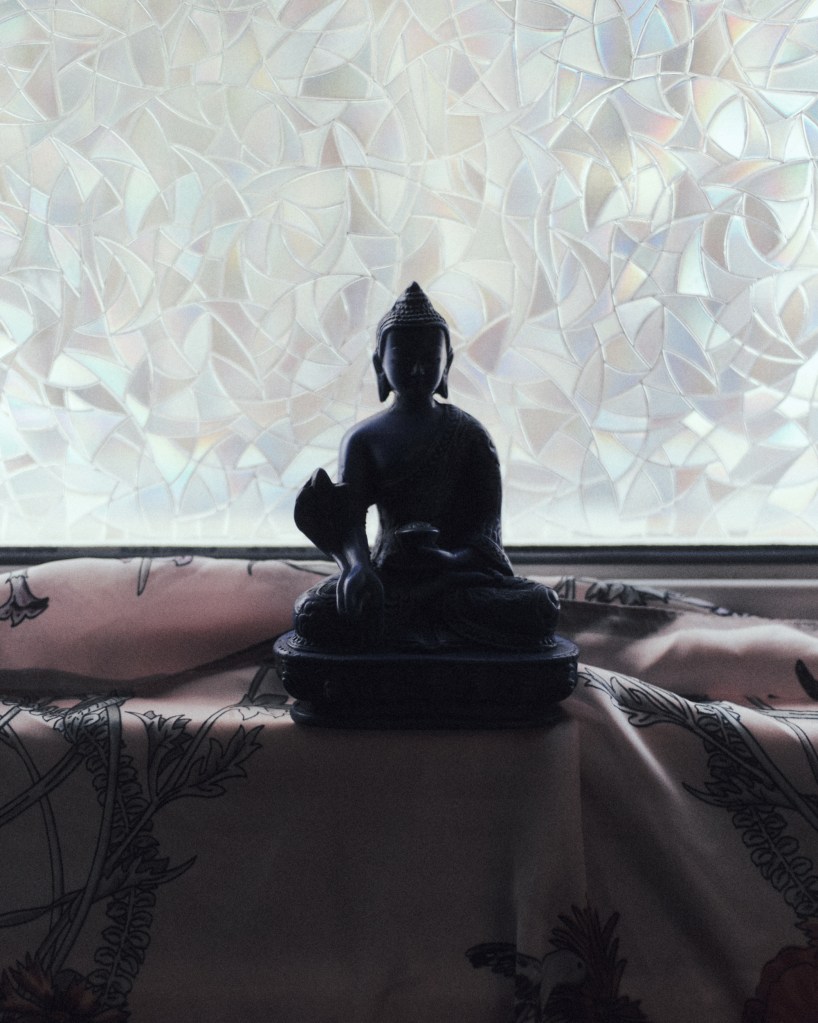
Traditional Thai Medicine, said to have been from the guidance of the “blue Medicine Buddha”, is a 4 elemental theory (5 in many other cultures systems’) –earth (din), water (nam), wind (lom), and fire (fai). Around the third century BCE, Thai people were introduced to a range of medicine systems by travelers visiting the country including but not limited to Ayurvedic medicine shared by Brahmins of India, Buddhist medicine introduced by Tibetan monks, and Traditional Chinese Medicine and new sects of Buddhism by Chinese monks. This blend became the foundation of Thai medicine which includes 4 main branches: medicine, midwifery, orthopedic, and massage. The traditional doctor masters all four disciplines.
These disciplines can be categorized by the four elements, or physical body, energy systems or the mind/heart continuum. Herbal medicine and midwifery manage issues related to the physical body. Thai massage and yoga focus the energy systems. Thai spiritual healing works on the mind/heart..
That being said, when I practice in Thai style – be in on the floor doing yoga massage or fire-cupping — it is with the aim to balance the spirit through the chi and also alleviate symptoms in the body.
What lens do you work through?
Post-punk/ queer/ painter/ martial arts + spiritually nerd/ trained anthropologist.
During both my massage trade program (2 years) and graduate school, I had the pleasure of being introduced to and studying a variety of cross-cultural healing methods and systems. Of course, one could easily spend lifetimes studying one alone! As a part of my practice, I primarily navigate through a Thai medicine theory lens as I was mentored by a teacher who utilizes this system. Because Thai medicine is ‘fairly new’ and a blend of Tibetan, Chinese, and Indian practice, it can be (kind of) thought of as a DIY / chaos magick approach (for those who that resonates with).
Resources regarding these topics (& related fields of study)
can be located here & on my 90s-style tumblr blog.
 Body Drift Healing Arts